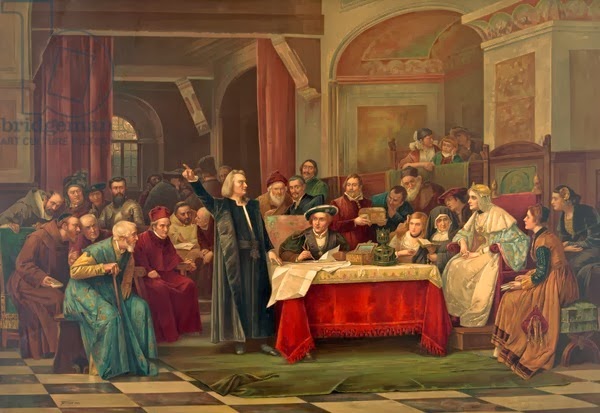
Galileo Galilei, the great Italian scientist who was
probably more responsible for the development of the scientific method than any
other individual, was born in 1564, in the city of Pisa. As a young man, he
studied at the University of Pisa, but dropped
out for financial reasons. Nevertheless, he was able, in 1589, to obtain a teaching position at that university.
A few years later, he joined the faculty of the University of Padua and
remained there until 1610. It was during this period that the bulk of his
scientific discoveries were made.
Galileo's first important
contributions were made in mechanics.
Aristotle had taught that heavy objects fall at a more rapid rate than
light objects, and generations of scholars had accepted this assertion on the
Greek philosopher's authority. Galileo, however, decided to test it, and
through a series of experiments, he soon found that Aristotle had been incorrect. The fact is that heavy and light
objects fall at the same velocity except