Friday, April 3, 2015

15.MOSES(THE 100 MOST INFLUENTIAL PERSONS IN HISTORY) History Of Sand.

15. MOSES f 1. 1 3 t h C. B.C.


Probably no person in history has been so widely admired as the great Hebrew prophet Moses. Furthermore, his fame, as well as the number of people who respect him, has steadily grown throughout the ages. It is most likely that Moses flourished in the thirteenth century B.C., since Ramses II, generally thought to be the pharaoh of the Exodus story, died in 1237 B.C. During Moses' lifetime, as the Book of Exodus makes clear, there were a fair number of Hebrews who disagreed with his policies. Within five centuries, however, Moses was revered by all the Jewish people. By 500 A.D., his fame and reputation had spread, along with Christianity, throughout much of Europe. A century later, Muhammad recognized Moses as a true prophet, and with the spread of Islam, Moses became an admired figure throughout the Moslem world (even in Egypt). Today, some thirty-two centuries after he lived, Moses is honored by Jews, Christians, and Moslems alike, and is even respected by many agnostics. Thanks to modern communications, he is probably even better known today than he was in the past.
Despite his renown, reliable information concerning Moses' life is scarce. There has even been speculation (not accepted by most scholars) that Moses was an Egyptian, since his name is of Egyptian, rather than Hebrew, origin. (It means "child" or "son," and occurs as part of the name of several famous pharaohs.) The Old Testament stories concerning Moses can hardly be accepted at face value, since they involve a large number of miracles. The stories of the burning bush, or of Moses turning his staff into a serpent, for example, are basically miraculous in nature; and it does tax one's credulity, perhaps, to believe that Moses, who was already eighty years old at the time of the Exodus, still managed to lead the Hebrews in a forty-year trip through the desert. Surely, we would like to know exactly what the real Moses accomplished before his story was buried in an avalanche of legends.
Many persons have tried to give natural interpretations to the Biblical stories of the ten plagues and the crossing of the Red Sea. However, most of the favorite Old Testament stories concerning Moses are legendary, with analogues in other mythologies. The story of Moses and the bulrushes, for instance, is strikingly similar to a Babylonian story concerning Sargon of Akkad, a great king who reigned about 2360-2305 B.C.
In general, there are three major achievements attributed to Moses. First, he is credited with being the political figure who led the Hebrews in the

14.EUCLID(THE 100 MOST INFLUENTIAL PERSONS IN HISTORY) History Of Sand.

14. EUCLID A. C. 300 B.C.


Few persons on this list have earned such enduring fame as the great Greek geometer, Euclid. Although in their lifetimes such figures as Napoleon, Alexander the Great, and Martin Luther were much better known than Euclid, in the long run his fame will probably well outlast theirs.

Despite his re-known, almost none of the details of Euclid's life are known. We do know that he was active as a teacher in Alexandria, Egypt, in about 300 B.C. However, his dates of birth and death are uncertain, and we do not even know on which continent he was born, much less in which city. Although he wrote several other books, some of which survive, his place in history rests primarily upon his great textbook of geometry, the Elements.
The importance of the Elements does not lie in any one of the individual theorems it demonstrates. Almost all of the theorems in the book had been known before Euclid, and a good many of the

13.ARISTOTLE(THE 100 MOST INFLUENTIAL PERSONS IN HISTORY) History Of Sand.

13. ARISTOTLE 3 8 4 B.C. - 3 2 2 B.C.


Aristotle was the greatest philosopher and scientist of the ancient world. He originated the study of formal logic, enriched almost every branch of philosophy, and made numerous contributions to science.
Many of Aristotle's ideas are outmoded today. But far more important than any of his individual theories is the rational approach underlying his work. Implicit in Aristotle's writings is the attitude that every aspect of human life and society may be an appropriate object of thought and analysis; the notion that the universe is not controlled by blind chance, by magic, or by the whims of capricious deities, but that its behavior is subject to rational laws; the belief that it is worthwhile for human beings to conduct a systematic inquiry into every aspect of the natural world; and the conviction that we should utilize both empirical observations and logical reasoning in forming our conclusions. This set of attitudes-which is contrary to traditionalism, superstition, and mysticism-has profoundly influenced Western civilization.Aristotle was born in 384 B.C., in the town of Stagira, in Macedonia. His father was a prominent physician. At seventeen,Aristotle went to Athens to study in the Academy of Plato. He remained there for twenty years, until shortly after Plato died. From his father,

12.GALILEO GALILEI(THE 100 MOST INFLUENTIAL PERSONS IN HISTORY) History Of Sand.

12.GALILEO GALILEI 1564 - 1642.


Galileo Galilei, the great Italian scientist who was probably more responsible for the development of the scientific method than any other individual, was born in 1564, in the city of Pisa. As a young man, he studied at the University of Pisa, but dropped out for financial reasons. Nevertheless, he was able, in 1589, to obtain a teaching position at that university. A few years later, he joined the faculty of the University of Padua and remained there until 1610. It was during this period that the bulk of his scientific discoveries were made.

Galileo's first important contributions were made in mechanics. Aristotle had taught that heavy objects fall at a more rapid rate than light objects, and generations of scholars had accepted this assertion on the Greek philosopher's authority. Galileo, however, decided to test it, and through a series of experiments, he soon found that Aristotle had been incorrect. The fact is that heavy and light objects fall at the same velocity except to the extent that they are retarded by the friction of the air. (Incidentally, the tradition that Galileo

11.LOUIS PASTEUR(THE 100 MOST INFLUENTIAL PERSONS IN HISTORY) History Of Sand.

11.LOUIS PASTEUR 1822 - 1895.


The French chemist and biologist Louis Pasteur is generally acknowledged to be the most important single figure in the history of medicine. Pasteur made many contributions to science, but he is most famous for his advocacy of the germ theory of disease and for his development of the technique of preventive inoculation.
Pasteur was born in 1822, in the town of Dole, in eastern France. As a college student in Paris, he studied science. His genius was not evident during his student days; in fact, one of his professors recorded him as "mediocre" in chemistry. However, after receiving his doctorate in 1847, Pasteur soon showed that his professor's judgment had been in error. His research on the mirror-image isomers of tartaric acid made Pasteur a renowned chemist when he was only twenty-six years old.
He then turned his attention to the study of fermentation, and showed that that process is due to the action of certain types of microorganisms. He also demonstrated that the presence of certain other species of microorganisms could produce undesirable products in the fermenting beverages. This soon led him to the idea that some species of microorganisms could pro-duce

10.ALBERT EINSTEIN(THE 100 MOST INFLUENTIAL PERSONS IN HISTORY) History Of Sand.

10.ALBERT EINSTEIN 1879 - 1955.


Albert Einstein, the greatest scientist of the twentieth century and one of the supreme intellects of all time, is best known for his theory of relativity. There are actually two theories involved: the special theory of relativity, formulated in 1905, and the general theory of relativity, formulated in 1915, which might better be called Einstein's Iaw of gravitation. Both theories are highly complicated, and no attempt will be made to explain them here; however, a few comments on special relativity are in order.
A familiar maxim has it that "everything is relative." Einstein's theory, however, is not a repetition of this philosophical platitude, but rather a precise mathematical statement of the way in which scientific measurements are relative. It is obvious that subjective perceptions of time and space depend on the observer. Before Einstein, however, most people had always believed that behind these subjective impressions were real distances and an absolute time, which accurate instruments could measure objectively. Einstein's theory

9.CHRISTOPHER COLUMBUS(THE 100 MOST INFLUENTIAL PERSONS IN HISTORY) History Of Sand.

9.CHRISTOPHER COLUMBUS 1451-1506.


Columbus, by attempting to find a westward route from Europe to the Orient, inadvertently discovered the Americas, and thereby had a greater influence on world history than he could possibly have anticipated. His discovery, which inaugurated the age of exploration and colonization in the New World, was one of the critical turning points in history. It opened to the people of Europe two new continents for the settlement of their expanding populations, and provided a source of mineral wealth and raw materials that altered the economy of Europe. His discovery led to the destruction of the civilizations of the American Indians. In the long run, it also led to the formation of a new set of nations'in the western hemisphere, vastly different from the Indian nations which had once inhabited the region, and greatly affecting the nations of the Old World.
The main outlines of Columbus's story are well known. He was born in Genoa, Italy, in 1451. When he grew up, he became a ship's captain and a skilled navigator. He eventually became convinced that it was possible to find a practical route to East Asia by sailing due west across the Atlantic Ocean, and he pursued this idea with great tenacity.

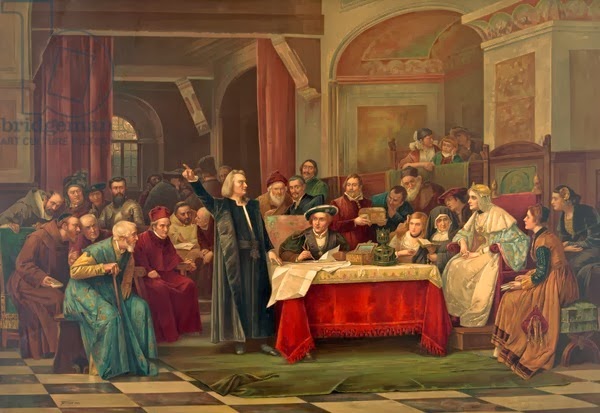
"Columbus before Isabella," by Vacslav Brozik.

Eventually, he persuaded Queen Isabella I of Ca stile to finance his